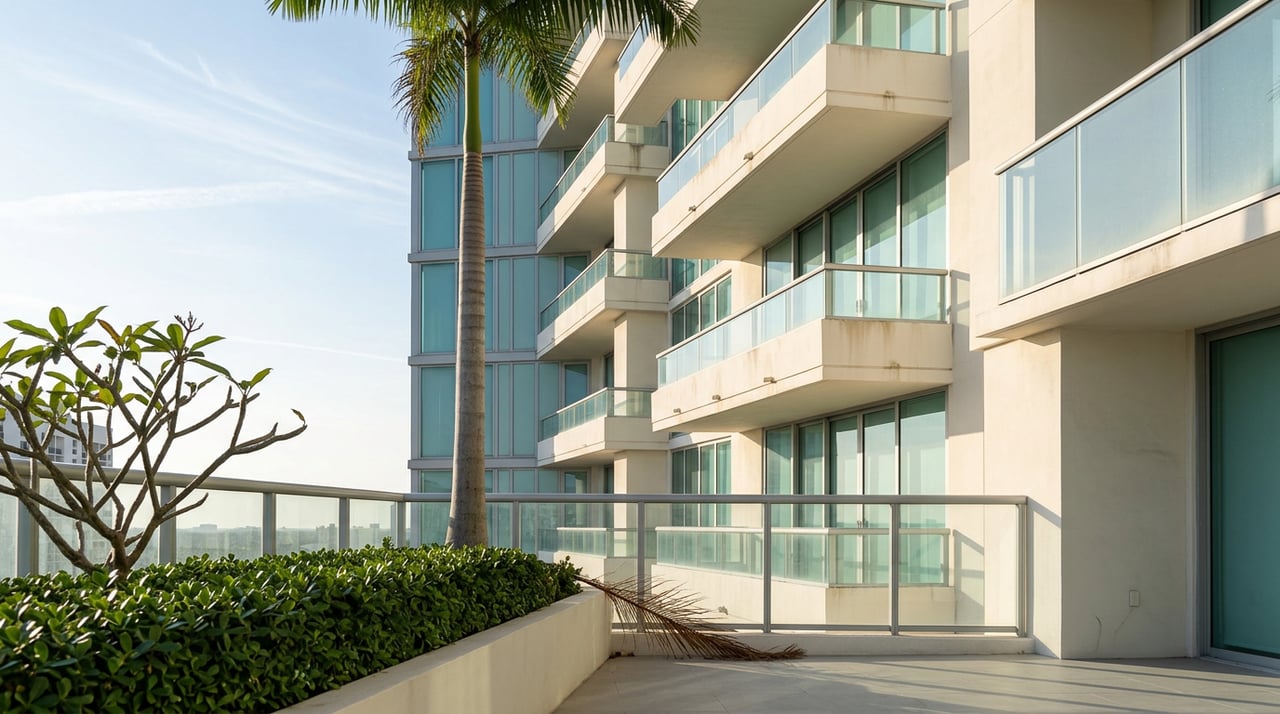
Stand at the corner of NE 29th Street and Biscayne Bay and you can see both. To the north, cranes are finishing Villa Miami, the Terra and Major Food Group tower rising in half-floor residences along the water. A few blocks south, a mid-rise from the 1990s holds its ground with hurricane shutters and a lobby that hasn't been touched since the Clinton administration. Both buildings will show up in a search for "Edgewater condo for sale." Only one of them is racing a legal clock that could cost its owners six figures.
That clock is not about location, view, or price per square foot. It is about a single date: the year the certificate of occupancy was issued. Florida's post-Surfside reserve law does not ask whether a building looks new. It asks how old the building actually is, and it treats those two answers very differently.
The mechanism buyers keep missing
Since 2022, Florida law has required condominium and cooperative buildings three habitable stories or taller to complete a Structural Integrity Reserve Study, known as a SIRS, and a milestone structural inspection on a set schedule. The trigger for the milestone inspection is age, not condition. A building is generally due for its first inspection at 30 years, or 25 years if it sits within three miles of the coast, which covers essentially all of Edgewater given its position on Biscayne Bay.
Here is the part that catches buyers off guard. The SIRS requirement itself is triggered by height, not age. A condominium finished this year still has to file a SIRS. So does a tower from 1996. The difference is what that study finds. In a brand new building, every roof, every pipe, every structural element has decades of remaining useful life, so the reserve number the study produces is small. In an older building, those same components may be approaching replacement, and the study has to say so, in dollars, with a funding schedule attached.
Ocho Edgewater, the roughly 80-unit tower at 800 Biscayne Boulevard delivered around 2023 to 2024, illustrates how far that clock actually stretches for new construction. Its first milestone inspection under the state's 30-year rule is not due until around 2048. That is not a rounding error. That is a quarter century of runway that an older building simply does not have.
What the construction boom is actually selling you
The current wave of Edgewater development gives buyers a lot to look at. EDITION Residences Edgewater is planned as a 55-story tower at 2121 N Bayshore Drive, designed by Arquitectonica with interiors by Studio Munge, expected to break ground in the third quarter of 2026. Villa Miami is already under construction at 710 NE 29th Street with 72 residences in half-floor layouts. ELLE Residences, a partnership between Vertical Developments and the fashion brand, is planned at 3618 NE 5th Avenue for delivery around 2027. HQ Residences, tied to Sam Nazarian's sbe and Marc Anthony, is planned for 422 NE 29th Street.
None of these buildings will be exempt from the SIRS requirement once they are occupied. What they will be exempt from, for a long time, is the funding pressure that comes with an aging structure. That is the actual product being sold in a new-construction Edgewater purchase: not just finishes and views, but decades of distance from a structural bill.
Resale buyers are shopping in a different aisle entirely, and the paperwork should reflect that.
What happens when the clock runs out
The law's funding rules are no longer theoretical. For associations that existed on or before July 1, 2022, the baseline deadline to complete an initial SIRS was December 31, 2025, unless the building's milestone inspection is also due by December 31, 2026, in which case the two can be completed together through that later date. Once a budget is adopted, owners can no longer vote to waive or underfund the reserves that study identifies. One industry guide summed up where that leaves Florida condo owners in 2026 plainly: "2026 is the year the bill came due."
What that bill looks like in practice varies by building, but nearby Miami-Dade towers show the range. Cricket Club in North Miami issued assessments around $134,000 per unit. Mediterranean Village in Aventura imposed assessments up to $400,000 per unit. Those are not Edgewater buildings, and I am not suggesting any specific Edgewater property is headed toward a number like that. I am pointing to them because they show what an underfunded reserve study can turn into once the law stops allowing boards to defer the math.
The document that tells you which building you're in
Fortunately, Florida law gives buyers a way to check before they sign anything. Under Florida Statute 718.503, a prospective purchaser is entitled to the condominium declaration, the current budget, the most recent milestone summary if one applies, and the most recent SIRS or a statement that one has not been completed. For a resale contract, the seller has to provide current versions of these at their own expense. Since December 31, 2024, resale contracts must also disclose whether a required milestone inspection, turnover inspection report, or SIRS has not been completed. That disclosure requirement did not exist a few years ago, and it exists now specifically because buyers were closing on units without knowing a structural bill was coming.
Owners and prospective buyers can also request official association records directly. Under Florida Statute 718.111, an association generally has to make those records available within 10 working days of a written request, and certain life-safety inspection reports must be retained for 15 years.
Before you write an offer on an Edgewater resale unit, this is the short list worth requesting:
- The certificate of occupancy date, which tells you which regulatory clock the building is on
- The most recent milestone inspection report, or confirmation of when it is due
- The current SIRS, or a written statement that one has not been completed
- The reserve funding schedule tied to that SIRS
- Board minutes from the last two years covering any discussion of special assessments
- The building's most recent annual budget and financial statement
If a seller or listing agent cannot produce these promptly, treat that delay itself as information.
The safety net exists, but don't plan around it
Miami-Dade County runs a Condominium Special Assessment Loan Program that offers qualifying owners, generally those earning under 140 percent of area median income, loans up to $50,000 toward assessment costs. The program was paused in August 2025 for restructuring and reopened with a new digital application system for a window that ran from June 1 through June 30, 2026, with priority given to applicants 62 and older. That window has already closed as of this writing. The program has historically reopened, but its timing is not predictable enough to factor into a purchase decision. If you are buying into a building with a known pending assessment, budget for the full cost yourself and treat any county assistance as a bonus, not a plan.
What this actually means if you're touring buildings this fall
The instinct to equate "new" with "safe" in Edgewater is reasonable and, based on how this law actually works, largely correct for the current construction wave. The instinct to assume an older resale building is automatically a financial trap is not. Some 1990s-era Edgewater buildings have already completed their SIRS, funded their reserves properly, and are sitting in exactly the position the state wants them in. The only way to know which category a specific building falls into is to ask for the documents and read them, not to judge by the lobby or the year on the building permit sign.
That is the actual work of buying well in this neighborhood right now. The view does not tell you the answer. The certificate does.
If you are weighing a specific Edgewater building against this exact set of questions, Jorge Hidalgo can walk through the reserve study, the milestone timeline, and the resale disclosure with you before you make an offer. Schedule a Confidential Consultation to get a clear read on where a building actually stands before you fall for the view.
A few direct questions
Does a brand new Edgewater tower need a SIRS if nothing is old enough to need repair yet? Yes. The SIRS requirement is triggered by building height, not age, so even a condominium finished this year has to file one. The numbers in that study will simply be small because nothing has aged into replacement.
If a seller says the assessment "isn't final yet," what does that mean for me as a buyer? Ask for the timeline in writing. Under the law, if a milestone inspection finds substantial structural deterioration, repairs cannot be delayed by a vote, and the association must move forward. A verbal assurance that something "probably won't happen" is not a substitute for the actual SIRS or board minutes.
Can financing fall through over SIRS status even if I'm paying cash? Financing risk is a lender issue, but cash buyers face a related risk. Buildings with unresolved structural findings or unfunded reserves can struggle with resale later, since the next buyer's lender will ask the same questions you should be asking now.
