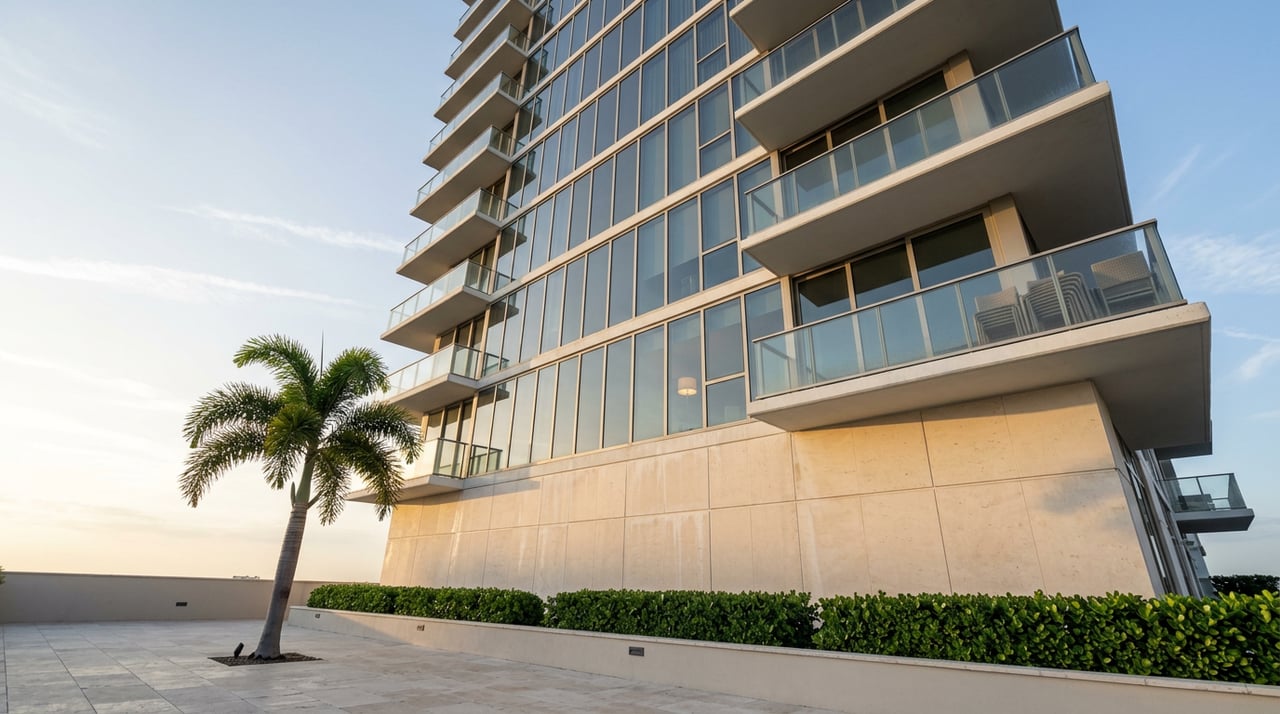
A buyer looking at two Downtown Miami condos, both priced around $730 a square foot, both closing in the same building cycle, might assume they're looking at the same kind of asset. They aren't. One of those units sits in a tower where the condo declaration allows daily rentals with no minimum stay. The other sits in a tower where the declaration requires a twelve-month lease before anyone can hand over a key. Same zip code, same price band, opposite rulebook. The city and county rules that most buyers check don't decide this. The building's own condo documents do, and they can override what the city allows.
That distinction is the whole story behind Downtown Miami's reputation as the "affordable" way into Greater Downtown's luxury condo market. The neighborhood really did close the first quarter of 2026 with the lowest median price per square foot among Greater Downtown's submarkets, at $730, against Brickell's record $950 and Edgewater's $978. But a single low median across an entire submarket almost always means the number is doing more averaging than describing. Here, it's averaging two products moving in opposite directions for different reasons, and a buyer who treats the neighborhood median as a discount signal is missing which side of that split they're actually buying into.
The Number Everyone Quotes, and What It Skips
Greater Downtown Miami, which in most market reports covers Brickell, Edgewater, and Downtown proper, closed Q1 2026 with an overall luxury condo price per square foot of $938, up 1.4 percent from the same quarter a year earlier and up 12.1 percent from the final quarter of 2025. Within that, Downtown Miami posted the lowest price per square foot of the three submarkets but the highest year-over-year appreciation, at 2.8 percent. Edgewater had the highest price per square foot at $978 and led the region in year-over-year sales growth, up 120 percent. Brickell posted the highest median sales price at $1.7 million and the fastest median time to sell, at 75 days.
Read quickly, that looks like three neighborhoods on three different trajectories. Read closely, it means Downtown is cheapest on paper while also gaining value the fastest, which is not a pattern you'd expect from a single, uniform market. It's the signature of a blended average: one tier pulling the number down, another tier pulling the appreciation rate up, and the neighborhood-wide figure landing somewhere in between without describing either one accurately.
What's Actually Inside the Low Half
Downtown Miami's biggest source of new inventory over the past several years has been Miami Worldcenter, the $6 billion, 27-acre mixed-use development spanning 10 city blocks in the Park West section of Downtown. The master plan calls for roughly 11,000 residential units and more than 1,000 hotel rooms across 16 towers, and several of the residential towers built inside it were designed from the start as rental-flexible investment product rather than owner-occupied homes.
600 Miami Worldcenter is the clearest example. The 32-story tower topped off construction in the fall of 2025 and is on track for completion in 2026, delivering 606 turn-key residences with no rental restrictions. It sold out before construction even started. Its developer, Merrimac Ventures, is also building The Crosby, a sold-out 450-unit condo with the same no-restriction rental policy, and Flow House, a 40-story, 466-unit tower developed in partnership with Adam Neumann's Flow. As of that same fall 2025 construction update, both were on track to complete by the end of that year. Together those three projects alone add more than 1,500 new homes built specifically for buyers who plan to rent, not live in, their units. Nearby, Aria Development Group's 501 First received its Temporary Certificate of Occupancy in December 2025 and began welcoming residents the following month, offering full daily rental flexibility and skipping a parking garage entirely to lean into a walkable, transit-first pitch to investors.
This is a lot of new supply chasing the same short-term rental buyer, delivering into the same few quarters. That kind of concentration is exactly what shows up as continued price pressure on rental-flexible product, even while overall Downtown numbers look stable.
The Other Half of the Average
At the same time, Downtown's branded, end-use inventory has been telling a different story. Okan Tower and E11EVEN Beyond, both cited among the notable Downtown transactions in early 2026 market activity, represent a different kind of product: branded residences positioned for owners who intend to live in the unit, not run it as a rental business. Market analysis covering the fourth quarter of 2025 pointed to this branded inventory as the specific driver pulling Downtown's resale price ranges upward, even as the rental-flexible towers around it absorbed pressure. That's consistent with Downtown posting the highest year-over-year appreciation in Greater Downtown despite having the lowest median. The appreciation isn't happening across the whole neighborhood evenly. It's concentrated in the tier that isn't competing on rental flexibility.
Here's how the two tiers compare on what's actually documented for each:
| Building | Rental Policy | Status as of 2026 |
|---|---|---|
| 600 Miami Worldcenter | No rental restrictions | Topped off at 32 stories in fall 2025, sold out pre-construction, on track for 2026 completion |
| The Crosby | No rental restrictions | Sold out, targeted for completion by end of 2025 per fall 2025 update |
| Flow House | Rental-flexible, developed with Flow | 466 units, targeted for completion by end of 2025 per fall 2025 update |
| 501 First | Full daily rental flexibility, no on-site parking garage | Received TCO December 2025, welcomed first residents January 2026 |
| Okan Tower | Branded, positioned for end-use owners | Cited among Q1 2026's notable Downtown activity |
| E11EVEN Beyond | Branded, positioned for end-use owners | Cited among Q1 2026's notable Downtown activity |
Why the Split Is Widening Right Now
Two things are compounding at the same time. First, Miami-Dade County and the City of Miami have both tightened oversight of short-term rentals, with the county requiring units rented for fewer than 30 days to register with its Tax Collector's Office and the city requiring a separate Certificate of Use for rental operations, as documented in a building-by-building rental policy review published in April 2026. Zoning in most of Downtown permits short-term rentals in commercially zoned, mixed-use buildings, which covers most of the new towers. But individual condo declarations can and do impose stricter rules regardless of what the city and county allow, which is why one tower can require a twelve-month lease minimum a block from another that permits nightly stays.
Second, the sheer volume of rental-flexible inventory hitting the market at once has left Downtown with more supply than it can absorb at current pricing. One Miami condo market intelligence newsletter classified Greater Downtown Miami as a "Severe Buyers Market" in its February 2026 report, a more specific designation than the general buyer-friendly conditions cited elsewhere in the market, and one that points squarely at oversupply as the driver of continued downward pressure on price in the affected segment.
What This Means If You're Comparing Neighborhoods
A neighborhood-wide median is a reasonable starting point, but in Downtown Miami right now it's not a reliable stand-in for what any specific building is doing. Two units at the same price per square foot can be on opposite sides of the same average, one absorbing oversupply in a crowded rental-flexible category, the other appreciating as part of a smaller, branded, end-use pool. The number that actually matters isn't the submarket median. It's the specific building's condo declaration, which will state its rental policy in plain terms and tell you which side of Downtown's split you're standing on.
A Couple of Direct Questions
How do I find a building's rental policy before I make an offer? The condo declaration and the developer's offering documents will state minimum lease terms and any restrictions on daily or short-term rentals. These are available for review before you sign anything, and they override general city or county zoning on the same question.
Does Downtown's low median mean prices are falling across the whole neighborhood? No. The median reflects a mix of a large rental-flexible tier under price pressure and a smaller branded tier posting the fastest appreciation in Greater Downtown. The two movements offset each other in the neighborhood-wide number without either one describing the whole picture.
If you're weighing a Downtown Miami condo against Brickell or Edgewater, the comparison that actually matters isn't neighborhood to neighborhood. It's building to building, declaration to declaration. Jorge Hidalgo works Downtown, Brickell, and Edgewater daily, with direct developer access into projects like these before they reach public listing, and can walk you through exactly which tier a specific building falls into before you commit. Schedule a Confidential Consultation to go through the numbers on the actual unit you're considering, not just the neighborhood average.
